Bihar to Lead in Renewable Energy: Two Pump Storage Power Houses of 2,120 MW to be Built in Nawada at a Total Cost of ₹13,000 Crore
Projects to be Completed within Six Years, Will Enhance Renewable Energy Generation and Storage Capacity
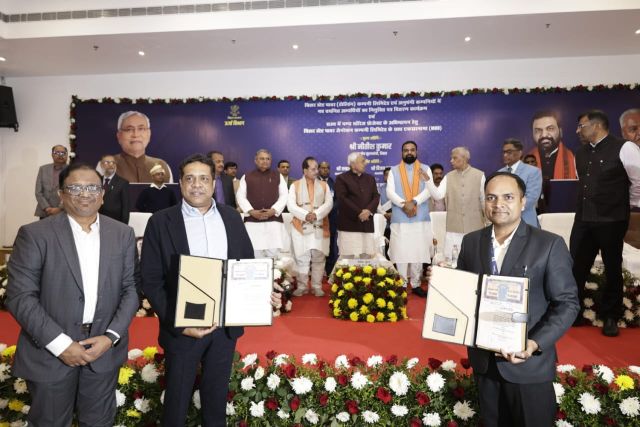
On Tuesday, Memorandum of Understanding (MoUs) were signed between Bihar State Power Generation Company Limited (BSPGCL) and selected agencies for the projects in the presence of Honorable Chief Minister Shri Nitish Kumar, Honorable Deputy Chief Ministers Shri Samrat Choudhary and Shri Vijay Kumar Sinha, Honorable Energy Minister Shri Bijendra Prasad Yadav, and Honorable Water Resources Minister Shri Vijay Kumar Chaudhary. Also present on this occasion were Chief Secretary Shri Pratyaya Amrit, Chairman of Electricity Regulatory Commission Shri Aamir Subhani, Secretary to Government of Bihar Shri Kumar Ravi, Secretary of Energy Department and Chairman-cum-Managing Director of Bihar State Power Holding Company Limited Shri Manoj Kumar Singh, Secretary to Honorable Chief Minister Shri Chandrashekhar Singh, MD of SBPDCL Shri Mahendra Kumar, and MD of NBPDCL Shri Rahul Kumar.
With the objective of strengthening energy security and promoting renewable energy in the state, the Bihar government has implemented the Pump Storage Policy-2025. Based on this policy, Bihar State Power Generation Company Limited has selected two agencies – GreenCo EnergiesPvt. Ltd. and Sun Petrochemicals Pvt. Ltd. Both these projects are proposed in the hilly areas of Nawada district, where the natural height difference is suitable for pump storage arrangement. The energy storage capacity of the project proposed by GreenCo Energies Pvt. Ltd. is 7,308 megawatts and the capacity of the Sun Petrochemicals Pvt. Ltd. project is 6,973 megawatts. Thus, the combined capacity of both projects is 14,281 megawatts.
These two projects will bring an investment of ₹13,000 crore to the state. During the construction phase of the project, approximately 8,000 people will get employment. Through these projects, Bihar will gain unprecedented capacity for integration of renewable energy, peak demand management, and maintaining grid stability. This will enable electricity consumers to get electricity at cheaper rates. This initiative started under the state government's pump storage policy is an important step towards making Bihar self-reliant and technically capable in the energy sector in the future.
“These Projects Will Enhance the State's Energy Security and Self-Reliance”: Shri Nitish Kumar
Electricity generation and grid stability in the state will increase. It will particularly help in balancing renewable sources like solar and wind energy. These projects will also enhance the state's energy security and self-reliance. This reflects Bihar's major step in the energy sector.
“Energy Department is Committed to Providing Uninterrupted and Clean Electricity to the People and Industries of Bihar”: Shri Bijendra Prasad Yadav
Both these projects of BSPGCL are strong proof that the Energy Department is committed to meeting the government's investment targets and fulfilling the state's growing electricity needs. Highlighting the importance of the projects, Honorable Energy Minister Shri Bijendra Prasad Yadav said, “Under the visionary leadership of Honorable Chief Minister Shri Nitish Kumar, the Energy Department is committed to providing uninterrupted and clean electricity to the people and industries of Bihar. There has been no electricity consumption problem in the state for the past five years.” The Energy Minister appealed to investors, saying, “Investors should survey in Bihar and present their utilities and industrial sectors to the government. In Bihar's growing development environment, the Bihar government is committed to energy conservation and employment generation. These two projects will not only help in fulfilling the state's energy needs but will also prove to be an important initiative towards achieving India's Net Zero emission target of 2070.”
